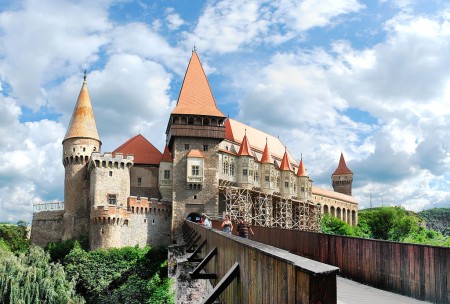
Hunyad Castle is situated in the South-West of Hunedoara City from Hunedoara county.
Summer Schedule (1.04 2014 - 30.09.2014)
Everyday: 09.00 AM – 08.00 PM
Last entry is 40 minutes before closing time.
In July 26 the Museum will be opened from 09.00 AM to 01.00 PM
In July 16, 18 and 19 during OPERA NIGHTS the Museum will be opened from 09.00 AM to 07.00 PM.
Winter Schedule (1.10.2014 - 31.03.2015)
Everyday: 09.00 AM – 05.00 PM
* opening hours may vary, they are just for guidance
Adults - 25 RON
Seniors - 10 RON
Students - 5 RON
Photo Tax – 5 RON
Video Tax – 15 RON
Guide Tax – 30 RON
Audio Guide Tax (for Android and iOS phones) – 6 RON
* visiting taxes may vary, they are just for guidance
The Hunyad Castle is the most important Gothic monument from Romania. It was built in several stages over four centuries. It all started in 1440, when John Hunyadi decided the transformation of the old citadel in an imposant castle.
First, there was designed the double wall for defense and the circular towers. The last ones were a new architectural elements of that period. Interesting is that The Capistrano Tower has the only Gothic fireplace from castle and in the Painted Tower is a fresco with geometrical motives inspired by those from German space. The architecture and the decorations of the castle prove that it was redecorated according to architectural trends of the time like German and Romanian Gothic style, Renaissance and Ecletic style, always in millitary purpose like defense or attack.
The Hunyad Casttle is the host of two beautiful legends. First, it is regarding at its name, ‚Corvin’. It is said that the child of John Hunyad has a golden ring which he forget outside in one day. A raven saw and tooked the ring but the child stroked the raven down and recovers the ring. When his father heard the story he decided that the family emblem will be a black raven with a golden ring in the beak. On the other hand, the ‚Corvus’ in latin means ‚raven’ and suggests longevity and wisdom.
The second myth is about the fountain from the middle of the courtyard. They say that John Hunyadi had three Turkish prisoners who promised their freedom if they would have dug the fountain. The legend says that after 15 years they found water but John died meanwhile and his wife didn’t released the prisoners. After this episode, the prisoners scratched on a brick fountain ‚You have water but no heart’. Actually, the inscription in Arabian character says: ‚Hassan, prisoner to the giaours in the fortress next to the church, dug here’.
The tourists come here to see the most representative monument of the military architecture from South-Est Europe of the XV century. It is also attractive because here were made several film productions about Romanian or Universal history: ‚François Villon’, ‚Vlad the Impaler’, ‚Michael the Brave’, ‚Alexandru Lapusneanu’, ‚Michelangelo Buonarotti’, ‚The Damned Kings’, ‚Vlad’, ‚Jacqou le Croquat’, ‚Blood Rayne’, ‚Martin Luther’, ‚Henry the 8th’.