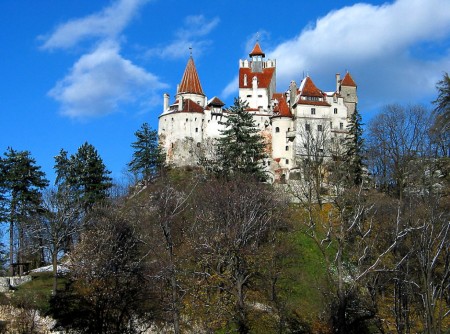
Bran Castle is located in Rucar-Bran Pass at 30 km West of Brasov city from Brasov county.
Summer Schedule (1.04 2014 - 30.09.2014)
Monday: 12.00 PM – 6.00 PM
Tuesday to Sunday: 9.00 AM - 6:00 PM
The last entry is at 6 PM.
Winter Schedule (1.10.2014 - 31.03.2015)
Monday: 12.00 PM – 4.00 PM
Tuesday to Sunday: 9.00 AM - 4.00 PM
The last entry is at 4 PM.
* opening hours may vary, they are just for guidance
Adults - 25 RON
Seniors (65+) - 15 RON
Students - 10 RON
Scholars – 5 RON
Free admission for disabled and institutionalized people.
Amateur photography: free
Filming: 20 RON
* visiting taxes may vary, they are just for guidance
Between 1377 - 1388, the Bran Castle was built after the decision of Louis I of Hungary who decided the construction of the castle in place of an old fortress which dated since 1211.
The castle was so strong than it needed repaired after four centuries. Its strategic posititon caused many sieges which decreased in number and strenght after moving Romanian boundary.
In 1920, the City Council of Brasov donated the castle to Queen Maria. It becames her favourite castle and she decided to restore and decorate it to be used as summer royal residence. The restoration works are executed by the same Czech architect who projected the Peles and Pelisor Castles, Karel Liman. In 1932, on the Turcu river was built an hydropower which helped to illuminate the castle for the first time.
The surrounding domain was designed as an english park and it had two lakes and a Tea House. In the same period, there are built the guest house, the wooden church, the house for stuff, stalls and car sheds. The elevator is executed later, after the queen fells ill and she was walking with more and more difficulty.
After Queen Maria’s death, the Princess Ileana received the castle by will in 1833. During The Second World War, The Princess established here an hospital and she became nurse.
In 1950, the Comunist Party forced the royal family to leave the castle and country. The comunists transformed the castle in 1956 in three departments: the castle which included some exhibits from royal family patrimony, the medieval customs and the Etnography (the traditional houses near the castle domain).
Between 1987 and 1993 the castle was in restoration and in 1993 it was opened as a museum for public. Since 2009, the castle is in the property of the royal family heritors, The Archduce Dominic, The Archduchesse Maria Magdalena and the Archduchesse Elisabeta who keep the castle in the tourism circuit of Romania.
The Bran Castle is associated with the legend of Dracula, the character from Bram Stoker novel (although the author never knew the existence of this castle). For that reason, it is also known as ‚Dracula’s Castle’ because of the confusion with Vlad III or Vlad the Impaler from House of Draculesti, a voivode of Wallachia who executed people by impaling.
It is true that the myth of Dracula attracts many tourists from all over the world. But once they come here they can see that for manager castle the historical value is a little more important that the legend of Dracula which is not promoted at Bran Castle as much as they expected.